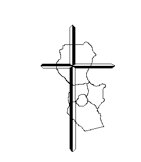
After their escape from Egypt, as the Israelites moved into Palestine, the tribes of
Zebulun and Nephtali settled in the northernmost part of Galilee. More than in the rest of
the country, the original occupants continued to remained in the area.
In 734 BC, King Tiglath-Pileser III and the Assyrian troops raided this part of Galilee.
They deported many Israelites and transplanted people from other nations in their
place. As hopeless as this situation was, the prophet Isaiah gave a message of
encouragement to the devastated people, “Land of Zebulun! Land of Naphtali! … Galilee
of the Nations! The people that sat in darkness have seen a great light. On those who
sat in a land overshadowed by death, light has arisen” (Is 8:23-9:1).
During the close of the second century and the start of the first century, before Christ,
the Maccabees expanded the nation of Judea, drawing upper Galilee back into Jewish
control. A number of settlers from Judea moved to Galilee. It is very possibly that Mary’s
and Joseph’s ancestors were among them
Approximately seven hundred and sixty years after the devastating destruction, Jesus
began preaching in northern Galilee. As seen in today’s Gospel (Mt 4:12-23), Matthew
does not consider Jesus initial mission to be a coincidence: “This was to fulfill what was
spoken by the prophet Isaiah” (Mt 4:14).
This area continued to have a mixed population, as many as half of the whom were
pagans or non-Jewish. Thomas Aquinas believes that Jesus began his mission in
“Galilee of the Nations,” home to both Jews and Gentiles, “to show that He called both.”
Isaiah speaks to “Those who walk in darkness and have no light yet trust in the name of
the Lord and rely upon God” (Is 50:10). Thomas observes that people with hope of
finding light can “walk” in darkness but those who are dazed stand still. The Jews
looked for an eventual resolution but the Gentiles had no hope.
Thomas affirms, “Light has dawned for the Gentiles, because they did not go to the
light, but the light came to them” (Commentary on the Gospel of Matthew, 16). John’s
Gospel announces: “The light came into the world” (Jn 3:19). Isaiah prophesied: “I will
give you as a light to the nations that my salvation may reach to the end of the earth”
(Is. 49:6). In Galilee, Jesus came to the nations.
Jesus came for people. The First Letter to Timothy states: “Christ Jesus came into this
world to save sinners” (1 Tim 1:15). Paul writes: “For all have sinned and need the glory
of God” (Rom 3:23).
Jesus calls the people to “Repent.” But He also promises something else: the kingdom
of heaven is at hand (Mt 4:17).
Thomas asserts that this is a new teaching: “The doctrine of Christ is called the New
Testament, because in it a new pact between us and God was struck concerning the
kingdom of heaven: ‘I will make a new covenant with the house of Israel and the house
of Judah’” (Jer 31:31).
For Thomas, “the kingdom of heaven is at hand,” means the possibility of “eternal
happiness.” He says “at hand,” “because the One who gave it came down to us, since
we were unable to go up to God” (Commentary on the Gospel of Matthew, 17).
Thomas explains the phrase, “As Jesus walked.”: “To walk signifies His birth in time.
Therefore, by the fact that when walking, He called His disciples signifies that He drew
us to Himself by the mystery of the Incarnation” (Commentary on the Gospel of
Matthew, 18). Christ came in our likeness: “God sent His Son in the likeness of sinful
flesh” (Rom 8:3).
Jesus invited others to join Him in His ministry: “After He began to preach, He wanted
ministers of His preaching. Hence, He calls them to Himself.” Thomas alerts us that
Jesus began with two sets of brothers:
“And note that the same thing is signified by two and brothers, for both pertain to
charity, which consists in the love of God and neighbor. Therefore, He chose, by
two’s, and by two’s, He sent them to preach. By this He wished spiritual charity to
be signified, because charity is made more firm, when it is founded on nature:
‘Behold, how good and how pleasant it is for brothers to dwell together in unity’
(Ps 133:1)” (Commentary on the Gospel of Matthew, 18).
Thomas reflects that “the New Law is based on charity.” Even two brothers, Aaron and
Moses were called, “because even there the command about charity was given.” Here
Jesus calls two sets of brothers, Simon and Andrew, James and John, because the
New Law is “even more perfect.”
Following the example of the disciples who quickly answered Jesus’ call, preachers are
obedient, comprehending and courageous, as Thomas explains:
“For a preacher should be obedient, that he might invite others to it: ‘The
obedient man shall speak of victories’ (Pr 21:28); comprehending, that he may
know how to instruct others: ‘I had rather speak five words with my mind, in order
to instruct others’ (1 Cor 14:19); courageous, in order not to be terrified by
threats: ‘I make you this day a fortified city, an iron pillar, and a bronze wall’ (Jer
1:18); ‘I have made your face hard against their faces, and your forehead hard
against their foreheads… adamant, harder than flint I have made your face’ (Ez
3:8).”
Jesus finds these first disciples casting their fishing nets into the sea. Jesus declares to
them: “Come after Me and I will make you fishers of men” (Mt 4:19). Thomas relates this
to the future call of preachers: “By this act the action of future preachers was prefigured,
for men are drawn by the words of the preacher as though by nets” (Commentary on the
Gospel of Matthew, 18).
Thomas considers fishermen to be simpler than other people: “The Lord wanted to have
and to pick men of the simplest condition, so that what they accomplished would not be
attributed to human wisdom” (Commentary on the Gospel of Matthew, 18). St. Paul
stated: “Consider your calling, brethren; not many of you were wise according to worldly
standards, not many were powerful, not many were of noble birth. But God chose what
is foolish in the world to shame the wise” (1 Cor 1:26).
Jesus invites them, “Come after Me.” Thomas reflects: “This is entirely from God’s
generosity that He draws them to Himself” (Commentary on the Gospel of Matthew, 18).
Later, Jesus announces: “Come to me, all who labor and are heavy laden, and I will
give you rest” (Mt 11:28).
Jesus says, “after Me.” Thomas understands this “As if to say: I go, and you come after
Me, because I will be your leader.” Words from the Book of Proverbs apply: “I will teach
you the way of wisdom; I will lead you into the paths of righteousness. When you walk,
your step will not be hampered; and if you run, you will not stumble” (Pr 4:11).
Jesus declares: “I will make you.” Thomas recalls God’s word in Jeremiah: “I shall send
for many fishermen, says the Lord, and these shall catch them” (Jer 16:16). Thomas
comments that Jesus announces “’I will make you’ because the preacher labors in vain
outwardly, unless the grace of the Redeemer is present inwardly; for it is not by his
power that he draws men but by the action of Christ” (Commentary on the Gospel of
Matthew, 19).
Thomas recalls the teaching of the fifth-century Syrian monk, Dionysius, “Nothing is
more dignified among men’s occupations than to be made a cooperator with God.”
Thomas observes “Those so enlightened as to enlighten others draw more closely to
that dignity.” The Book of Daniel announces: “Those who turn many to righteousness
shall shine like the stars forever and ever” (Dan 12:3).
Thomas points out the obedience of the disciples: “immediately they abandoned their
nets and followed Him” (Mt 4:22). They were prompt. Sirach teaches: “Do not postpone
from day to day” (Sir 5:7). Paul writes of his quick response to God’ call: “But when he
who had set me apart before I was born, and had called me through his grace…, I did
not confer with flesh and blood” (Gal 1:15). Isaiah also asserts: “The Lord God has
opened my ear, and I was not rebellious, I turned not backward” (Is 50:5).
Thomas notices that it was not the amount of what they left but the affection with which
they left it since wealth is an obstacle to virtue as it lessens the desire for eternal things.
Thomas compares this to the single-mindedness of athletes: “Every athlete exercises
self-control in all things” (1 Cor 9:25).
Thomas calls attention to the words, “They followed Him” (Mt 4:22). Thomas insists that
leaving all things in itself is not perfection:
“For it is no great thing to leave all things, but perfection consists in following, which is
through charity: ‘If I give away all I have, and if I deliver my body to be burned, but have
not love, I gain nothing’ (1 Cor 13:3). For perfection per se does not consist in external
things, namely, poverty, chastity and the like, except in the sense that they are
instruments to charity. Therefore, he says ‘followed him’” (Commentary on the Gospel of
Matthew, 20).
Thomas affirms that Jesus called them “inwardly and outwardly.” He explains: “To call
inwardly is no more than to offer help to the human mind, when He wills to convert us”
(Commentary on the Gospel of Matthew, 21).
Thomas questions whether the disciples should have left their father alone with the
nets: “The answer is that a counsel never conflicts with a precept; but ‘honor your father
and mother’ is a precept. Therefore, if a father can in no way live without help from his
son, the son should not enter the religious life” (Commentary on the Gospel of Matthew,
21).
Thomas notices that the Gospel says that “Jesus went about” (Mt 4:23). He recalls
Paul’s admonition: “Never flag in zeal” (Rom 12:11). Jesus did not make distinctions:
“Let us go on to the next towns that I may preach there also” (Mk 1:38).
Thomas points out that the Gospel says that Jesus “taught in their synagogues,
proclaiming the good news of the kingdom” (Mt 4:23). Thomas compares “teaching” with
present realities and “preaching” with future ones. Some have proposed that “teaching”
applied to natural virtues but Thomas differs: “Natural virtues do not seem able to be
called virtues, because virtues exist through grace. The answer is that the inclination
and beginning is natural; but the perfection, by which a man is made pleasing, is from
grace, discipline and from habit” (Commentary on the Gospel of Matthew, 23).
Jesus sought out “the multitudes.” His preaching was confirmed by miracles of healing:
“Disease can refer to bodily sickness; infirmity to infirmity of the soul, for the infirmities
of the soul are not less than those of the body.”
Thomas concludes that preachers should confirm their preaching with signs: “We are
also given to understand by that, that preachers should confirm their teaching with
works; if not by miracles, then by a virtuous life” (Commentary on the Gospel of
Matthew, 23).
Jesus still comes to us and speaks to us. Pope Francis chose the third Sunday of each
year as the “Sunday of the Word of God.” Pope Francis begins his letter, Aperuit illis,
with words from the Gospel of Luke, “He opened their minds to understand the
Scriptures” (Lk 24:45).
Pope Francis explains: “The relationship between the Risen Lord, the community of
believers and sacred Scripture is essential to our identity as Christians. Without the Lord
who opens our minds to them, it is impossible to understand the Scriptures in depth. Yet
the contrary is equally true: without the Scriptures, the events of the mission of Jesus
and of His Church in this world would remain incomprehensible. Hence, Saint Jerome
could rightly claim: ‘Ignorance of the Scriptures is ignorance of Christ’ (Commentary on
the Book of Isaiah)” (Aperuit illis, 1).
Pope Francis hopes that we will “experience anew how the risen Lord opens up for us
the treasury of his word and enables us to proclaim its unfathomable riches before the
world” (Aperuit illis, 2). The Pope recalls the words of the great Syrian father, St.
Ephrem, “Those who study it [the Scriptures] can contemplate what stirs them. He has
hidden in His word all treasures, so that each of us may find a richness in what he or
she contemplates” (Commentary on the Diatessaron, 1, 18).
Pope Francis draws the connection between faith and hearing the Scriptures: “Since
faith comes from hearing, and what is heard is based on the word of Christ
(cf. Rom 10:17), believers are bound to listen attentively to the word of the Lord, both in
the celebration of the liturgy and in their personal prayer and reflection” (Aperuit illis, 7).
The Pope emphasizes the role of the Holy Spirit in teaching us through the Scriptures:
“The work of the Holy Spirit has to do not only with the formation of sacred Scripture; it
is also operative in those who hear the word of God. The words of the Council Fathers
are instructive: sacred Scripture is to be ‘read and interpreted in the light of the same
Spirit through whom it was written’ (Dei Verbum, 12). God’s revelation attains its
completion and fullness in Jesus Christ; nonetheless, the Holy Spirit does not cease to
act. It would be reductive indeed to restrict the working of the Spirit to the divine
inspiration of sacred Scripture and its various human authors. We need to have
confidence in the working of the Holy Spirit as he continues in his own way to provide
‘inspiration’ whenever the Church teaches the sacred Scriptures, whenever the
Magisterium authentically interprets them (cf. Dei Verbum, 10), and whenever each
believer makes them the norm of his or her spiritual life. In this sense, we can
understand the words spoken by Jesus to his disciples when they told him that they now
understood the meaning of his parables: “Every scribe who has been trained for the
kingdom of heaven is like a householder who brings out of his treasure what is new and
what is old” (Mt 13:52)” (Aperuit illis, 10).
Denis Vincent Wiseman, O.P.
The quotations from St. Thomas Aquinas can be found in his Commentary on the
Gospel of St. Matthew, translated by R.F. Larcher, O.P.